System Crash of Sydea
Systema Delenda EstThe System Crash of Sydea is the climax of Cato’s campaign on Sydea and the clearest demonstration of what removing the System actually means. Cato does not merely defeat a local administrator or close a portal: he dismantles the anchors that make the planet’s monsters, towns, dungeons, economies, and even portions of its landscape possible. The result is both emancipation and catastrophe. Sydea’s inhabitants become free to live under ordinary physics, but they inherit a damaged planet whose atmosphere, terrain, ecosystems, and institutions must be rebuilt.
Causes and Preparation
Cato’s intervention begins from the larger crisis created when the System arrived on Earth. Its imposed physics made technology fail, produced monsters, and killed billions, while scattered postbiological humans eventually mounted a decade-long campaign to expel it from Earth. Cato carries that struggle into the wider System, using advanced technology and civilizational knowledge rather than the System’s own magic. Sydea therefore becomes a test of whether liberation can be engineered from within a world whose basic reality has been organized around the System.
The immediate operation depends on identifying and removing the planet’s System anchors. The first signs of failure appear after the thirty-first dungeon closes. System displays on warframes in Sydea’s eastern hemisphere begin to fade in and out, with no error message and no explanatory warning. The disruption is not presented as a clean administrative shutdown; it is a silent loss of access, suggesting that the System’s hold is distributed across overlapping material and metaphysical supports.
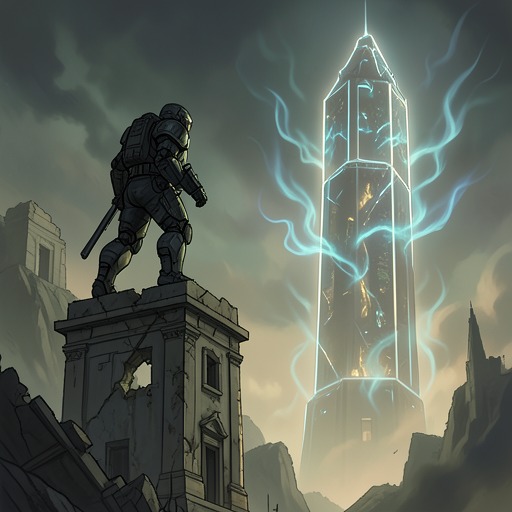
Cato determines that the pylons inside the System Nexus buildings are especially important. They enable teleportation, quests, the sale of goods, and the management of towns, forcing Sydea’s population to depend on the System’s infrastructure. He begins demolishing the eastern pylons where the failure has already started. The System crystals resist monomolecular claws, but Cato’s light-gas guns can crack the material at point-blank range, turning a seemingly esoteric structure into a vulnerable engineering target.
Course of the Crash
Korek Town is the first place to experience a complete crash. Its distinction is geographical rather than political: it lies farthest from another System Anchor when Cato pulverizes its pylon. The pylon puffs into dust and disappears, and the surrounding reality changes with it. Monsters vanish, colors alter, and sections of flora dissipate. The scene establishes that the System has not merely been governing Sydea from above; it has been continuously maintaining the visible world.
The collapse also makes it possible to extract the System Interface from the gem in Onswa’s office. Cato’s mindripper software maps the Interface in a process closer to brain emulation than true digitization, because the disruption has pushed the Interface into an unusually exposed and overstimulated condition. The preliminary copy is sufficient for Cato to destroy the city anchor as well, extending the breakdown from one remote town to the administrative machinery of Sydea.
The decisive removal is the planetary Nexus. On Sydea, unlike Earth, the capital-level anchor has not already been eliminated, and the System-God responsible for the world has abandoned it. Cato therefore cannot know in advance what will happen when the Nexus is removed. Once he destroys it, every other town appears to lose power, or more precisely, essence. Lights go out, stores shut down, and the System retreats. Ordinary physics, native biology, and ordinary ecology spread through regions that had previously been sustained by System infrastructure.
The physical landscape changes on a planetary scale. Mountains crumble or vanish, broad lakes become muddy plains, storms form without warning and disappear, grasslands shift toward native life, and alien forests wither. Some transplanted organisms do not simply vanish with the System but die, leaving enormous scars that may persist for years or decades. The process resembles terraforming accelerated beyond any natural timescale, yet it is also a reversal whose outcome cannot be reduced to a simple return to Sydea’s pre-System condition.
The final dungeon to disappear is the Platinum-ranked dungeon, where massive burrowing metal wyrms have challenged Cato’s four warframes. He reaches its core, crushes it, and transmits himself away, watching from orbit as the quarry wavers and vanishes. This is the final blow. The transparent portals in Sydea’s two major cities shrink simultaneously, waver, and disappear, ending the planet’s direct connection to the System’s wider infrastructure.
Liberation and Immediate Consequences
The crash changes the meaning of daily life for Sydea’s inhabitants. People can walk beyond the town walls without being attacked for the first time. They can look at the sky without fearing winged monsters. Children born under the System’s rule are no longer confined to combat and the whims of godlings; they possess the possibility of choices outside the imposed game. The narrative’s brief declaration that they are free is earned through these concrete changes in movement, safety, education, and futurity.
Sydea is now bound to ordinary physics. Its people can establish genuine civilizations, practice art and architecture, develop philosophy and science, and eventually expand toward the stars. The planet lies thousands of light-years from Sol according to the pulsar positions, so liberation also creates distance: Cato may wait a very long time to hear from Earth, and he cannot rely on communications from other versions of himself elsewhere in the System. The world gains an independent future at the cost of immediate connection to the civilization that freed it.
The freedom is not painless. The crash exposes how much of Sydea’s environment had been artificially supported. The loss of System-maintained structures affects mountains, lakes, forests, weather, monsters, flora, shops, and transportation at once. A society designed around System towns and services must survive after those services disappear. Cato’s victory therefore carries an obligation that conquest would not: he must replace the infrastructure he has destroyed while preventing the newly liberated population from dying during the transition.
Reconstruction and the Cost of Freedom
The ecological consequences become the central problem in later System-crash operations. When Cato considers a comparable assault on Haekos, he anticipates total ecosystem collapse, including the possible loss of single-celled organisms responsible for producing oxygen. The System regulates atmospheres across portals despite differences in pressure and composition, but ordinary reality cannot ignore the small biological processes that make breathing possible. Cato is particularly concerned about the oceans, whose altered coasts may behave unpredictably when System support ends.
Heyk demonstrates the severity of that danger. After its System collapse, the world is nearly uninhabitable and would become so within months without intervention. Massive flora die-offs reduce oxygen levels, while the absence of native bacteria capable of breaking down alien biomatter leaves weathered plant husks intact instead of allowing them to decay and re-enter natural cycles. Reconstruction consequently requires more than rebuilding towns: it demands atmospheric management, biological remediation, food production, and the restoration of nutrient circulation.
The social transition is equally unstable. Some inhabitants of Heyk attempt to burn grain crops rather than grow food, because the shift away from the System is so abrupt that Cato’s intended agricultural program appears to them as part of an apocalypse. Their resistance reveals the paradox at the center of Sydea’s liberation: the System was oppressive, but it also supplied the conditions under which ordinary life had been organized. Removing it gives people autonomy while abruptly withdrawing the familiar rules and resources on which they depend.
Cato’s wider campaign therefore requires industrial preparation and distributed reconstruction. Exponential growth across hundreds of worlds supplies factories, mines, refineries, solar panels, weapons, warframes, and infrastructure that can be redirected between production and war. Yet even such vast capacity cannot make planetary restoration instantaneous. Sydea’s biological factories are prepared for the scars left by the crash, but the text preserves the difference between technical power and ecological time: a civilization can accelerate terraforming, not abolish consequence.
Narrative Significance
The System Crash of Sydea turns the book’s political slogan into a material dilemma. The System is not only a tyrannical authority that assigns quests and empowers godlings; it is also an environmental regime embedded in the planet’s geology, atmosphere, species, settlements, and economy. Its destruction is therefore a liberation from domination and a disaster of infrastructure at the same time. Cato must destroy the mechanism that sustains oppression even though he knows that its disappearance will harm people who did not choose the transition.
The event also establishes the recurring pattern of Cato’s war: slow preparation followed by abrupt systemic failure. Exponential growth can appear almost motionless while Cato hides in a lunar crater with a few drones, a rudimentary solar array, and a hacked-together manufactory; once enough anchors, factories, and forces exist, the accumulated pressure produces a planetary tipping point. Sydea is the first major proof that the System can be undone, but it is also a warning that every later liberation will demand a plan for the world left behind.
Most importantly, the crash separates freedom from comfort. Sydea’s future is no longer limited to combat, quests, monsters, and divine caprice, yet its inhabitants must endure vanished landscapes, dead transplanted life, collapsed services, and years of ecological repair. The event’s decisive achievement is not that Cato makes Sydea safe immediately. It is that he makes a genuine future possible, then accepts the long responsibility of ensuring that ordinary physics, biology, culture, and civilization can occupy the space the System once monopolized.